
What is a machete used for?
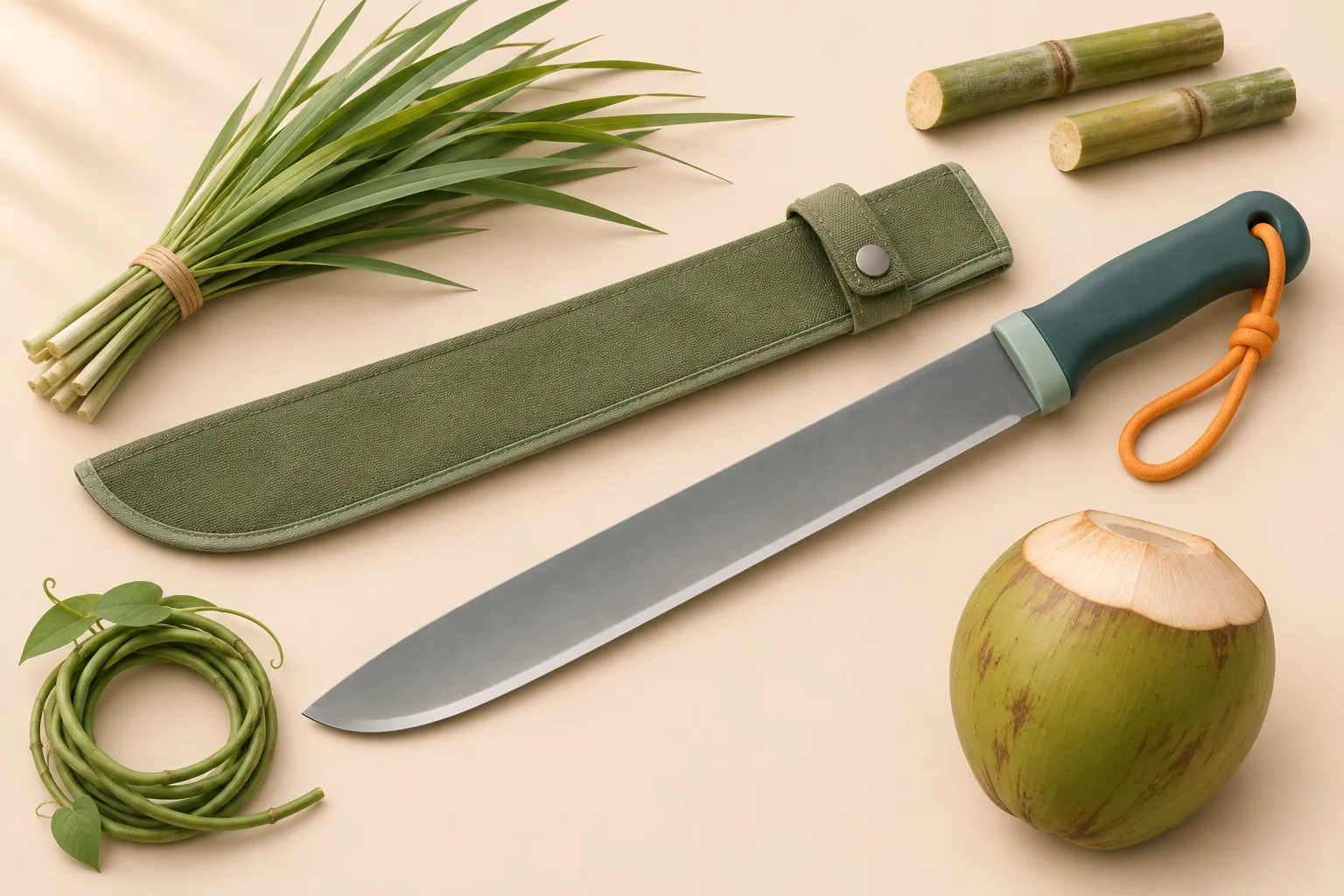
A machete is a long, thin, single-edged blade, commonly 20 to 24 inches, made for cutting soft vegetation in one sweep. It began as a farm tool in the tropics, and that is still its main job: cutting sugar cane, clearing weeds and brush, harvesting crops, opening coconuts. Swing a machete at grass and it moves faster than shears. Swing it at seasoned oak and it bounces.
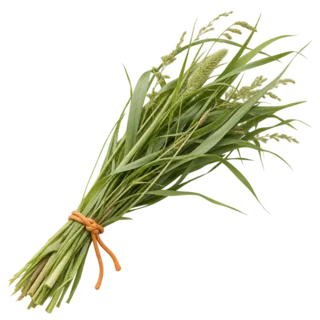
Tall grass and weeds
Overgrown corners and ditch banks that a mower cannot reach.
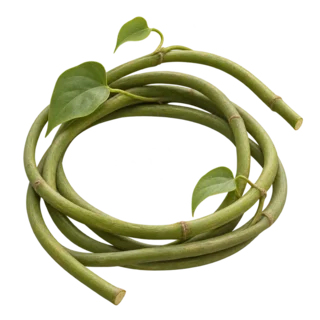
Vines and brambles
Kudzu, ivy and blackberry canes wrapped around a fence or tree.
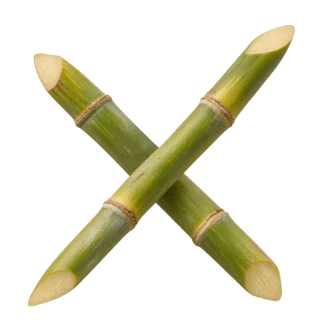
Cane, bamboo and stalks
Sugar cane, corn stalks, banana stems and green bamboo, cut low in one stroke.
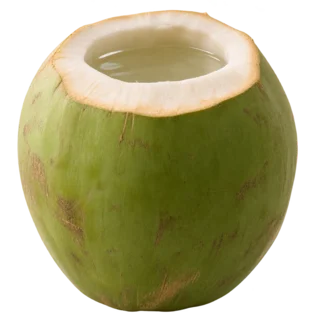
Coconuts and fruit
Trimming the husk and opening a green coconut, or chopping a ripe bunch of bananas.
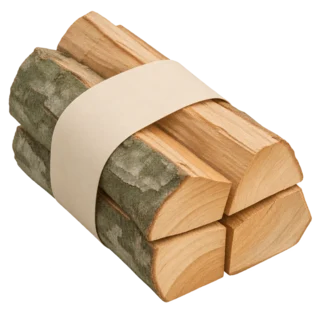
Kindling at camp
Splitting thin, dry sticks you collected where that is allowed. Not for logs.
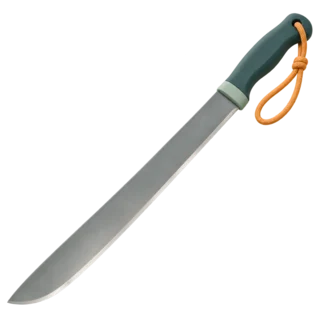
Survey and field lines
Surveyors use one to clear a line of sight through brush.
The thin blade is light for its length, so you can swing it all afternoon. On hard, dry wood it sticks or chips, and it will not split a round. That is the job of a hatchet or an axe, which have a thick wedge behind the edge.
Will a machete cut wood?
Green saplings and branches up to about an inch thick, yes. Beyond that, a saw is safer and faster. The Colorado local-government risk pool CIRSA, in its job safety sheet for machete work, tells crews to cut branches over one inch with a hand saw or chain saw. A heavier blade such as a kukri or a thick bolo handles wood better than a thin Latin machete, but none of them replaces a saw.
What is a machete used for in gardening and agriculture?
In agriculture the machete is still a working tool across Latin America, Africa and Southeast Asia, used for harvesting cane, cutting weeds between rows, and chopping crop waste. At home in the US, the garden jobs are smaller:
- Cutting back overgrown perennials
- Clearing a fence line of vines
- Chopping corn and sunflower stalks for compost
- Cutting ornamental grass in late winter
- Taking down invasive brambles
For pruning a living tree or shrub, use pruners or a pruning saw. A machete leaves a ragged cut, and a ragged cut on a branch you want to keep heals poorly.
How to use a machete safely
The danger is a swing that keeps going after the cut: into the shin, the foot or the hand holding the plant. These steps follow the CIRSA machete job sheet and the field crews’ basic rule of chopping away from your body.
Look first. Check what is hidden in the growth, from old wire and stones to a wasp nest. A blade that hits wire or rock glances back.
Clear the circle. Keep at least 10 feet from anyone else, more for children and dogs. Nothing should be inside the reach of the blade, including your own feet and free hand.
Grip it firmly. Full grip on the handle, wrist strap on if it has one. Never hold the plant you are cutting with your other hand.
Stand wide. Feet apart, stable footing, the cut on the side away from your legs.
Swing at an angle. Cut with a diagonal, downward stroke and let the blade’s weight do the work. On stems and brush, an angled cut slices where a square chop bounces.
Stop the follow-through. Plan where the blade ends after the cut. It must finish in empty space, never toward your leg or across your body.
Rest before you are tired. Tired arms make wild swings. Take breaks and stop when your grip weakens.
Never swing across your body. If the cut needs a backhand stroke toward your legs, change your position instead. Do not cut above shoulder height, where the blade can come back at your face.
Clearing brush, weeds and grass
For grass and weeds, use a low, flat-ish stroke a few inches above the ground, moving forward in a line. Do not strike the soil: dirt and stones dull an edge in minutes. For brush and vines, cut stems at the base with diagonal strokes, then pull the cut growth back with a stick or rake. Keep your hand out of the pile. With thick stems, cut from two sides in a V rather than hacking at one spot. Cane and bamboo are cut low at an angle; the angled stump is less likely to catch a boot.
Walk with the blade sheathed. If you must carry it bare for a few steps, hold it by the handle at your side, edge down and pointing back, and never on your shoulder. If you fall, toss it away from you. Keep a first-aid kit with pressure bandages close by. Deep cuts to the leg or hand need direct pressure and medical care.
Types of machete and what each is for
There are dozens of regional patterns. For most people, four shapes cover nearly every job.
Latin machete
Long, straight and thin, the classic pattern from Central and South America. Best for grass, cane and light brush.
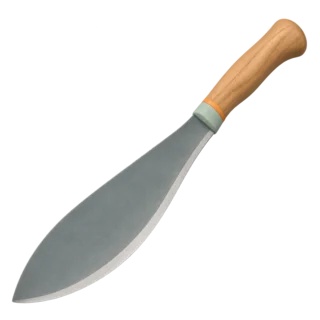
Bolo
From the Philippines. Shorter, with a wide belly near the tip that adds weight to each cut. Good for thicker stems and farm work.
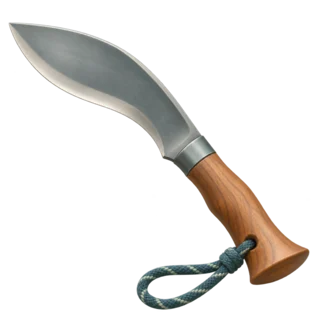
Kukri
A Nepalese pattern bent forward with its weight near the tip. Chops wood better than a thin machete, with less reach.
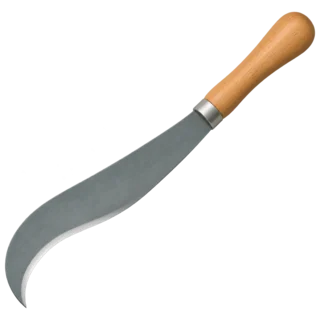
Billhook
A European hedging tool with a hooked tip. Pulls brambles and stems toward the cut; used for hedge laying and coppicing.
Other names you will see, such as the parang, golok, panga and cane machete, are regional cousins of these shapes. Pick by the job: a thin, long blade for grass and cane; a heavier, shorter one for woody brush; a saw for anything thicker than your thumb.
Machete vs sword, and when a knife becomes a machete
A machete is a tool: thin, flexible steel, usually with no guard, sharpened for vegetation and cheap to replace. A sword is built for fighting, with a thicker, stiffer blade and a guard. There is no legal or industry length at which a big knife turns into a machete. Makers use the name loosely, so the same 10-inch blade may be sold as a machete or as a large knife. New York’s proposed bill S1980 defines a machete as “a large heavy knife with a broad blade, used primarily for cutting brush or vegetation.”
Machete laws: is it legal to own or carry a machete?
In the US there is no federal law against owning a machete, and it is sold in hardware and farm stores in every state. Carrying one is a separate question. Federal law does not set general knife-carry rules, so they come from the states and, in about half of them, from cities and counties too. The American Knife and Tool Institute (AKTI) notes that about half of the states do not preempt local knife rules, so a city ordinance can be stricter than state law.
The main things that change how a machete is treated:
- Open or concealed
- Where you are: school, court, event
- Work, farm or camp purpose
- Your age
- How you behave with it
Carrying a machete to a job, a garden or a campsite, sheathed, is ordinary. Walking around town with one in your hand is different. So is carrying it “for protection.” Depending on the state, that can lead to charges such as brandishing or carrying a dangerous weapon.
Three state examples
Texas. A blade over 5½ inches is a “location-restricted knife” (Penal Code 46.01). Adults may carry one, but not in the places listed in section 46.03, such as high school, college and professional sporting events. Under 18, carrying one away from your own premises or vehicle without a parent’s supervision is a Class C misdemeanor (46.02).
California. A fixed blade worn openly in a sheath on the waist is not considered concealed (Penal Code 20200, as summarized by AKTI). Concealed, a long fixed blade can count as a “dirk or dagger,” which is a crime under Penal Code 21310. Several California cities add their own limits.
Florida. State law counts any knife other than a common pocketknife as a weapon (790.001). Concealed carry of a weapon is an offense for anyone who is neither licensed nor eligible for a license under 790.06. Openly carried for work, a machete is not what that law addresses.
New York’s bill S1980 would ban selling or giving machetes to people under 18. As of November 2026 it is in committee and has not become law.
Check your own state and city. This is general information, not legal advice. Before you carry a machete in public or in a car, read your state’s statute and your city’s ordinances. AKTI keeps free state-by-state summaries with statute links.
Can you carry a machete in your car?
In most states, yes, if it has a reason to be there: gardening gear, a camping trip, work tools. Keep it sheathed and in the trunk or cargo area. Under the seat or in a door pocket, within the driver’s reach, it can count as concealed. That can be an offense in states such as Florida and California, and local ordinances can add limits where the state does not preempt them.
Can you bring a machete on a plane or through TSA?
Not in your carry-on. TSA allows knives in checked bags only. The TSA knives page reads “Carry On Bags: No,” “Checked Bags: Yes.” Any sharp object in a checked bag must be “sheathed or securely wrapped” so screeners and baggage handlers do not get cut. TSA officers do find machetes at checkpoints. For international trips, check the rules of the country you land in too. Many are stricter than the US, and some require a declaration or ban long blades outright.
Can you carry a machete while hiking or camping?
Carrying one sheathed in a national park is generally allowed. The National Park Service definition of a weapon (36 CFR 1.4) covers firearms and devices that shoot missiles and does not list knives. It does add any weapon your state prohibits. Using it is another matter. In national parks, 36 CFR 2.1 prohibits destroying or removing plants. On national forests, 36 CFR 261.6 prohibits cutting trees or other forest products, and 261.10 prohibits building or maintaining a trail without written authorization. State parks have similar rules.
In practice, you do not need a machete on a marked trail in the US, and on the Appalachian Trail or any other maintained route you should not cut anything. Trail work is done by crews and volunteers with permission. So what is a machete used for on a trip? Mainly work on private land with the owner’s consent, everyday jobs in the tropics, and kindling at a campsite where wood gathering is allowed. For general camp tasks, a folding saw and a small knife weigh less.
Planning a hike? Check the park or forest’s rules page before you pack any cutting tool.
Keep a machete in good shape
Wipe the blade after use, especially after cutting green plants. Sap and moisture start rust overnight. Rub on a thin coat of oil. Store it dry, sheathed and out of reach of children. Touch up the edge with a file or a stone before it gets really dull.
Machete questions
What is the original purpose of a machete?
Agriculture. Machetes were made for cutting sugar cane, clearing land and harvesting crops in the tropics, and farm work is still their main use worldwide.
Is it illegal to own a machete?
No. We found no US state that bans owning a machete. Some states and cities restrict how, where and at what age you may carry one.
Can you open carry a machete?
In many states, an openly worn, sheathed machete is legal for work or camping, but some cities ban carrying long blades in public. Check the state statute and local ordinance.
Can you legally walk around with a machete?
Walking to a job or a campsite with a sheathed machete is usually legal. Walking around town with an unsheathed one, or carrying it to threaten someone, can lead to charges in many states.
Can you take a machete camping?
Yes, sheathed, for kindling where wood gathering is permitted. Do not cut live plants: see the hiking section above for the federal rules.
What is the hole in a machete for?
Usually a lanyard hole in the handle, for a wrist strap so the tool cannot fly out of a sweaty hand. Thread a cord through it and loop it around your wrist before you cut.
Are machetes sharp?
Not very, out of the box. Budget machetes usually ship with a rough factory edge that needs a few minutes with a file before it cuts cleanly.
Can I use a machete in my garden?
Yes, for weeds, vines, tall grass and soft stalks. Use pruners or a saw for branches you want to keep, and keep children and pets well away while you work.
Ready to plan a trip? Find a route and check its rules before you pack a cutting tool.