
A trip plan left with a trusted person lets a search start even before you signal. Signals then turn a rough search area into one spot that a ground team can hear or an aircraft crew can see.
We cover the methods in the order they usually work on a trail. Sound carries through forest, light and color work in open ground, and large symbols work only for aircraft. Pack the few items that make this possible, and practice them once at home.
How to signal for help in the wilderness: what to do first
Stop moving when you are lost or someone cannot continue. Then work through these steps, in this order, while you still have daylight and battery.
Call or text for help. Call 911 if you have any signal. Where text-to-911 works, a short text can get through when a call drops. Give your location and the problem, then save battery with low-power mode between attempts.
Activate a beacon or satellite SOS. A personal locator beacon or a satellite messenger reaches rescuers without cell coverage. Leave it switched on and pointed at open sky.
Make sound at regular intervals. Give three blasts on a whistle, rest, then repeat. Listen between series for voices, whistles or engines.
Make yourself easy to see. If a clearing is a few minutes away on safe ground, wait there; otherwise stay where you are. Spread a bright jacket or tarp and keep a mirror or light ready.
Protect yourself while you wait. Shelter, warmth and water keep you able to signal for hours. Searchers need you awake when they come within range.
If you can reach a known trail with certainty, staying on it helps searchers too. When you are unsure where you are, stay put. The National Park Service advises moving only if there is an immediate threat to your life.
The international distress signal: three of anything
In North America a signal given three times, with a pause between series, is read as a call for help. That includes three whistle blasts, three shouts, three flashes of light, three fires or three piles of rocks. The Alps use a different rhythm, covered below.
Sound
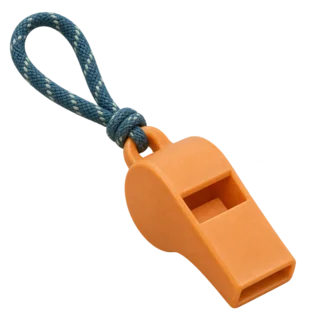
Three whistle blasts or three shouts, then silence to listen.
Light
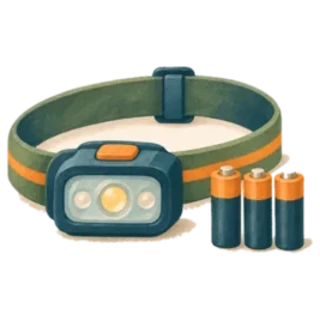
Three flashes of a headlamp or flashlight, or SOS in Morse code.
Fire and smoke
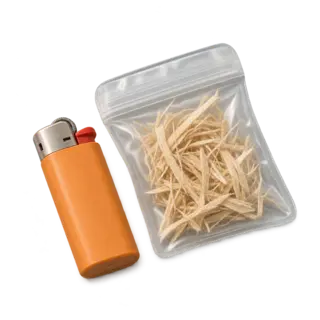
Three fires set in a triangle or a line, where fire is safe and lawful.
SOS in Morse code (three short, three long, three short) is understood worldwide. Use it with light at night. With sound, three plain blasts are easier to keep up and easier for others to recognize.
Emergency whistle signals
An emergency whistle is the cheapest signal you can carry and the one you will use most. The National Park Service emergency plan advises three blasts, a pause and a repeat, because a whistle saves the energy you would spend yelling. The Army survival manual reports whistles heard up to about a mile away. A pealess plastic whistle still works when it is wet or frozen.
Three blasts in North America
- Three blasts, a pause, then repeat.
- Listen between series for an answer.
- Keep a steady rhythm you can hold for hours.
Alpine distress signal in Europe
- Six blasts in a minute, then a minute of silence, repeated.
- Three blasts in a minute is the reply.
- The same rhythm works with flashes of light.
Blow short, hard blasts of about a second, then rest. Replies vary between groups and countries, so in a group agree on the whistle signals before the hike and check that everyone carries a whistle on the outside of the pack, where it can be reached with one hand.
How to use a signal mirror
A signal mirror throws a flash of sunlight that aircraft crews and people on distant ridges can see from far away. The US Army survival manual FM 21-76 calls it the best signaling device on a sunny day and reports flashes seen up to 160 km (about 100 miles) under ideal conditions. It needs sunshine, so it is a daytime tool. A purpose-made mirror has a sighting hole that makes aiming far easier than with a phone screen or a compass mirror.
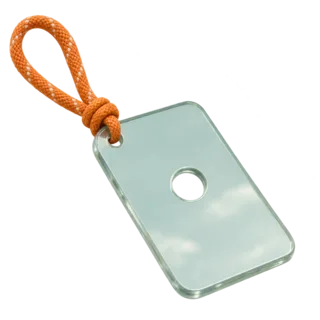
Practice on a sunny day.
Aim at a distant tree or rock from a hillside at home. Ten minutes of practice makes the sighting hole easy to use under stress.
Catch the sun. Hold the mirror just below your eye with the reflective side out. Find the flash on your hand, a rock or the ground.
Line up the target. With a sighting hole, look at the target through it and tilt the mirror until the bright spot you see sits on the target. Without one, make a V with your other hand around the target and steer the flash onto your fingers.
Sweep slowly across the target. Rock the mirror so the flash passes over the aircraft or ridge again and again. Stop flashing a helicopter once the crew has seen you.
Sweep the horizon anyway. Flash along the skyline from time to time even when you see and hear nothing. Crews can spot a flash before you hear the engine.
SOS with a flashlight or headlamp at night
At night even a small headlamp stands out against the dark, and searchers look for lights. Give three flashes or the SOS pattern (· · · — — — · · ·) toward the sound of a team or an aircraft, then wait. Skip the red mode, which is too weak for signaling; use white or strobe, and a steady white beam aimed at the searchers is easier to follow when they are close.
Save the battery for when it counts. Signal when you hear or see searchers, and in short series at regular times. Keep spare batteries warm in an inside pocket.
Fire and smoke signals
Smoke is visible from the air in daytime and fire is visible at night. Use it only when you can keep it under control: check fire restrictions, clear the ground, stay away from dry grass and overhanging branches, and never leave it. In a dry forest a signal fire can start the next emergency.
Build the fires in an open spot, ready but unlit, and light them when you hear an aircraft. Three fires in a triangle or a line, about 25 meters (80 feet) apart, are the international distress signal in FM 21-76; if you cannot manage three, one well-tended fire is better than three neglected ones. Smoke needs contrast: green leaves make white smoke that shows against dark forest, while dark smoke shows against snow or pale rock.
Ground to air signals for search aircraft
Ground to air signals are large symbols laid out on open ground so pilots can read them from the air. The FAA ground-air visual code for survivors is short: four letters and an arrow cover most needs. Make the lines long, straight and in strong contrast with the ground.
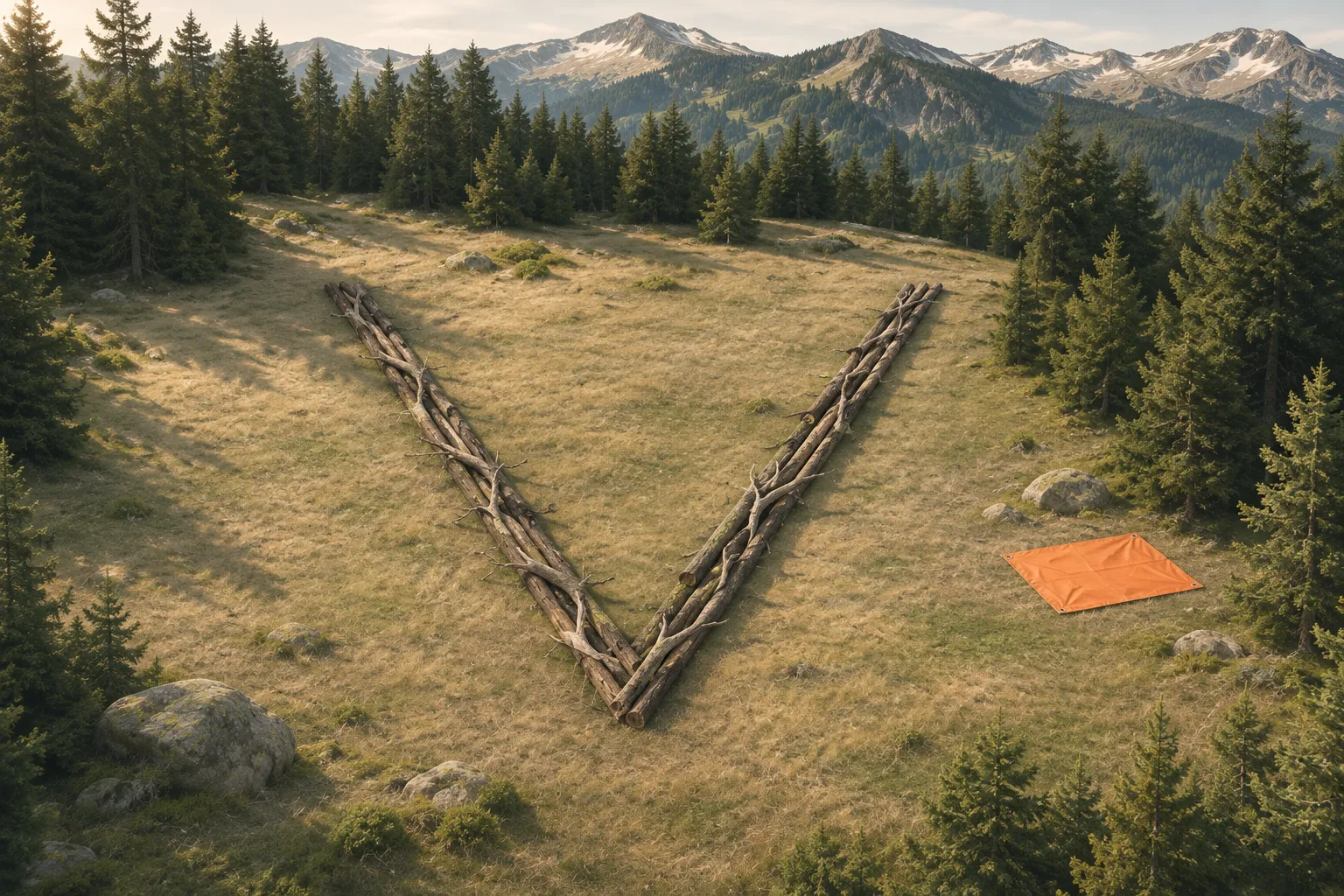
V: require assistance. The most useful symbol for a lost or stranded party.
X: require medical assistance. Someone is injured or ill and needs a medical team.
Arrow: proceeding in this direction. Use it only if you must leave the spot.
Y: yes, and N: no. Answers to questions from a crew that can reach you by message or loudspeaker.
The FAA asks for symbols at least 10 feet (3 meters) high, and bigger is better. If in doubt, lay out SOS. Use logs, rocks, packed snow, branches or bright gear. Clear a strip of snow down to dark ground, or lay dark branches on pale ground; the contrast matters more than the material.
Body signals to an aircraft
If a plane or helicopter passes low, stand in the open. In the FAA body signals, both arms raised straight up means “pick us up”. One arm raised overhead means “all OK, do not wait”, so never wave with one arm when you need help. The FAA chart adds lying flat with arms stretched out for urgent medical help, used only when a life is at stake.
When a helicopter comes to you
Secure loose items. Rotor wash throws jackets, tarps, hats and branches. Pack them away or weigh them down.
Protect your eyes and stay put. Crouch with your back to the wind and keep the group together, well away from the landing area.
Wait for the crew. Never walk toward the aircraft until the pilot or a crew member signals you to come. Stay low and well clear of the tail rotor.
Pack a small signaling kit
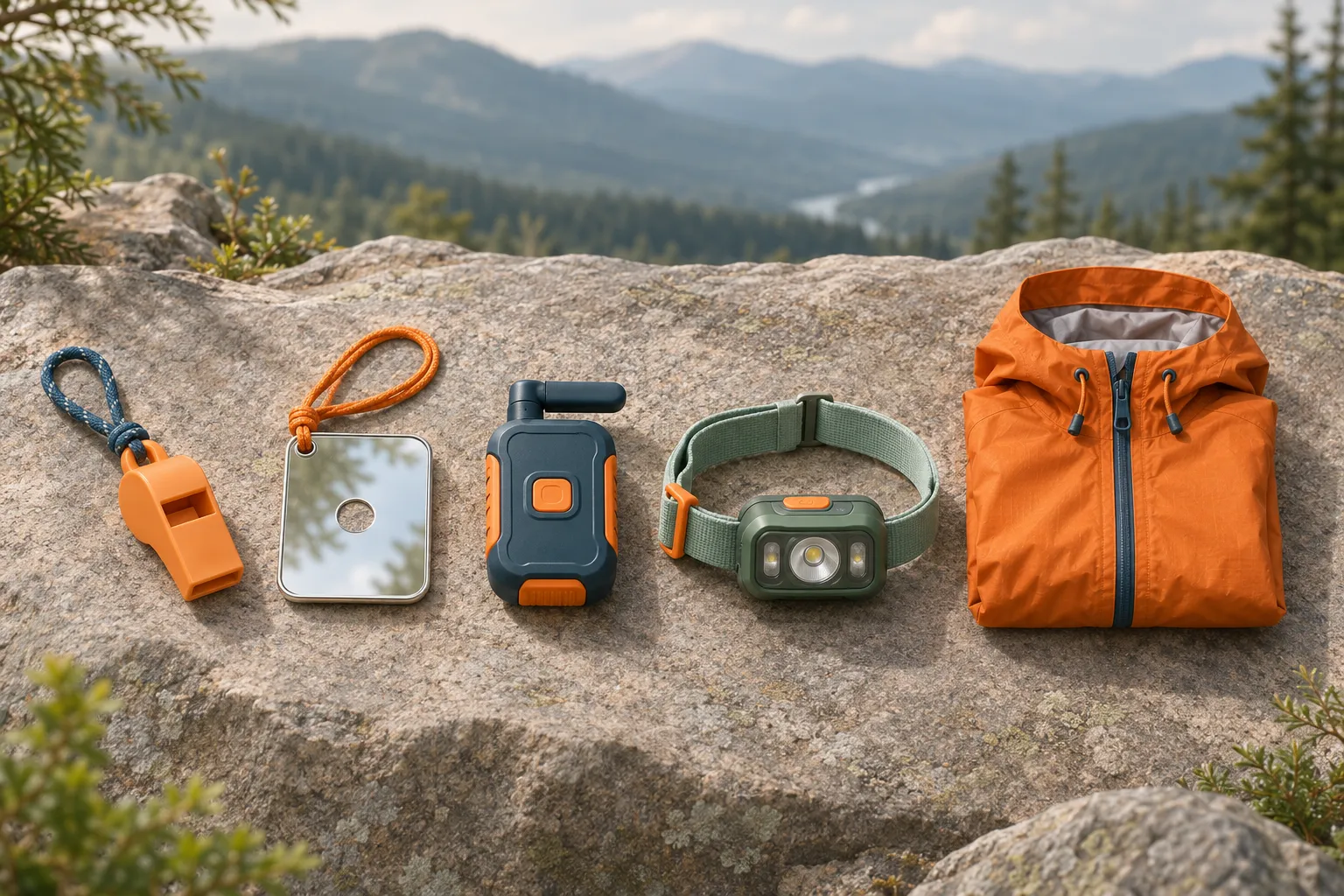
The whistle and mirror fit in a hip-belt pocket; the light, bright layer, phone and beacon go in the lid or top of the pack, where you can reach them without unpacking.
A personal locator beacon sends a distress alert with your position to search and rescue through the worldwide Cospas-Sarsat satellites. In the US you must register a 406 MHz beacon with NOAA; it is free and renewed every two years. A satellite messenger adds two-way texts but needs a subscription, and recent iPhones can text emergency services by satellite in supported countries. Both are worth carrying on remote, solo or off-trail trips. Learn how to read your coordinates in our GPS and UTM coordinates guide, so you can give a precise location if a call goes through.
Questions about signaling for help
What are three ways to signal for help?
Sound, light and marks on the ground: a whistle, a mirror or light, and a large V laid out in the open.
What is the universal distress signal?
SOS (· · · — — — · · ·) is understood worldwide. On land in North America, any signal repeated three times also means help.
What does 3 whistle blows mean?
In North America, three blasts mean help. In the Alps, six blasts a minute mean help and three blasts are the reply, so agree on a code with your group before a trip abroad.
How far can a signal mirror be seen?
The US Army survival manual reports flashes seen up to about 100 miles away under ideal conditions. Haze, clouds and a low sun shorten that a lot, but the range still beats a voice or whistle.
How do I signal a plane for help?
Get into the open. Use a signal mirror in sunshine, a light at night, smoke in daytime, and a large V on the ground. Raise both arms straight up when the aircraft is close.
How to signal for help in the wilderness with no phone signal?
Try 911 anyway: an emergency call may connect through any available network. Then use a beacon or satellite SOS if you carry one, and switch to whistle, mirror and ground signals.
Prepare before you need it. Add the signaling kit to your ten essentials and learn to give your location from a map or GPS.