
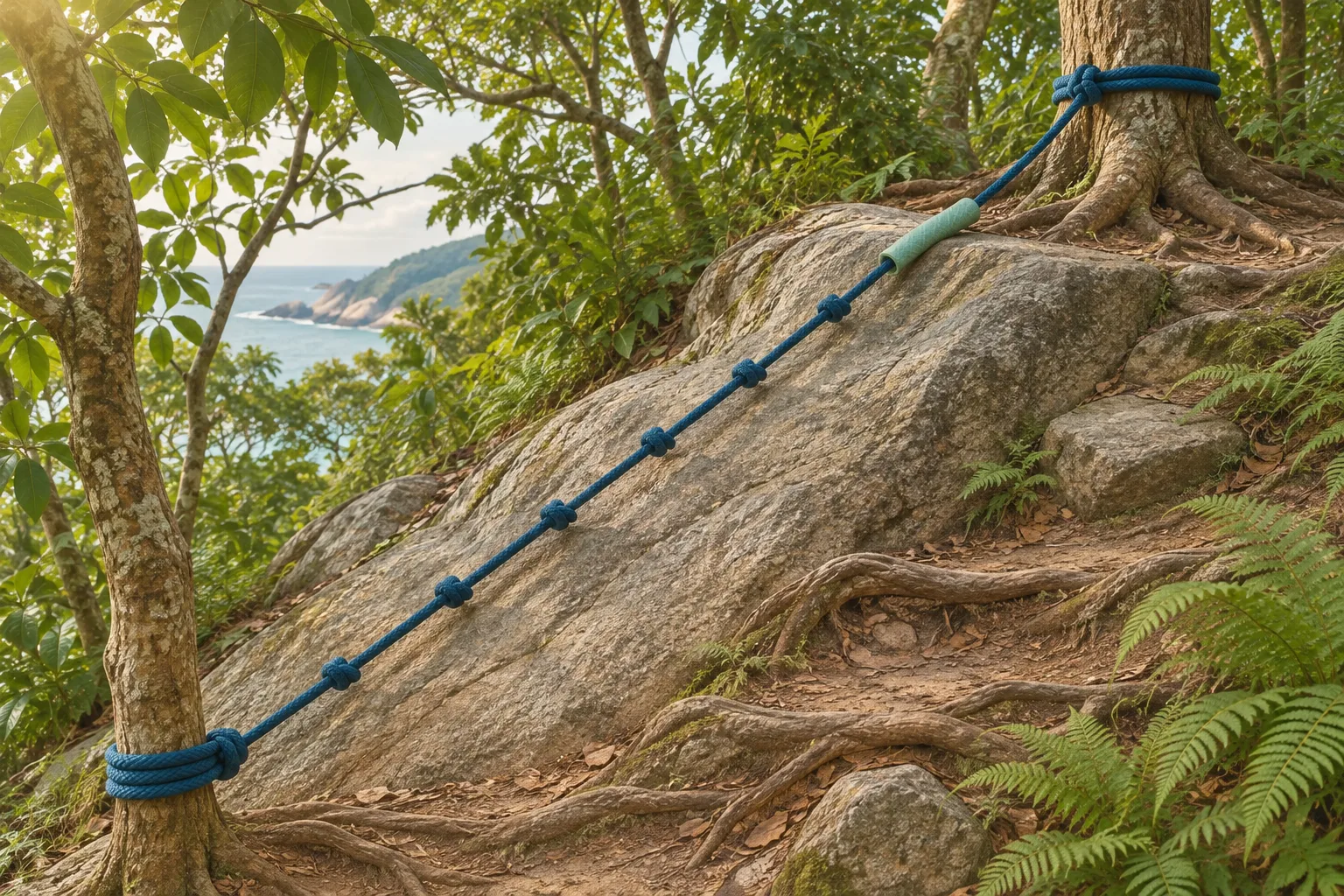
Best rope for outdoor use: polyester
A rope tied on a trail sits in sun, rain and mud day after day. UV slowly breaks down the fibers. Rope maker Marlow rates fibers for UV resistance on a five-point scale: polyester 5, UV-treated nylon 4, polypropylene 2. Yale Cordage puts it in words: polyester has “excellent UV resistance,” nylon “moderate.”
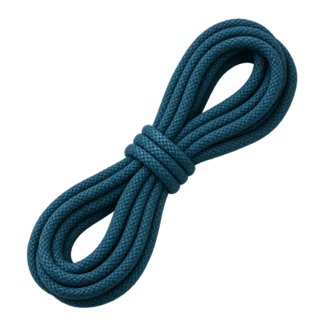
Braided polyester (static)
Smooth sheath over a core. Low stretch, keeps its strength wet, holds up best in sun.
Our first choice: firm, and it lasts longest.
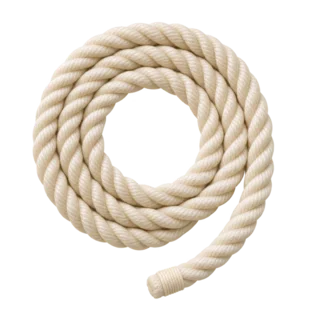
Three-strand polyester
Twisted rope, cheaper per meter and easy to grip. Knots hold well in it.
Easy to grip; dirt collects in the twists.
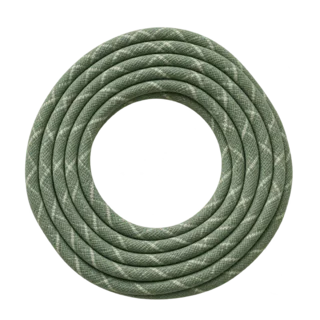
Nylon
Strong and stretchy. It absorbs water and loses strength when wet, and fades faster in sun.
Fine to carry, weaker to leave outside.
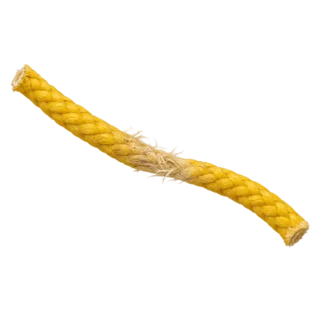
Polypropylene
The cheap, bright, floating rope. Sun breaks it down far faster than polyester.
Avoid for anything people will trust.
Nylon and polypropylene: why they lose outdoors
Nylon is the better rope for absorbing a shock, which is why climbing ropes use it. That stretch is a minus on a hand line: it sags when someone leans on it. Yale notes nylon “absorbs water, reducing strength when wet,” and a New South Wales government rigging guide puts the loss at up to 20%. Samson describes polyester as “as strong as nylon, but with much less stretch and wet-strength loss.”
Polypropylene is the rope you see on boat docks and in hardware bins. Certex, a rope distributor, calls it “far more susceptible to UV degradation” than polyester or nylon. Natural fibers such as manila and cotton rot when they stay damp, so leave them for camp chores.
Hiking rope diameter, length and weight
Thicker rope is easier to hold with wet or tired hands. We would carry 11–12 mm braided static rope or 12–14 mm three-strand. Anything thinner is hard to grip when it is muddy.
Length: 15–20 m. Enough for most short steep steps, with rope to spare for the anchor wrap and the bottom tie.
Static, not dynamic. Static rope barely stretches: Sterling lists 1.9% elongation at 300 lb for its 11 mm HTP. A climbing rope is built to stretch, and a hand line that stretches feels loose.
Weight: about 2 kg for 20 m. Maker specs: Sterling 11 mm static about 97 g per meter, Marlow 12 mm three-strand polyester 110 g/m. So 20 m weighs 1.9–2.2 kg, about as much as a full 2-liter bottle.
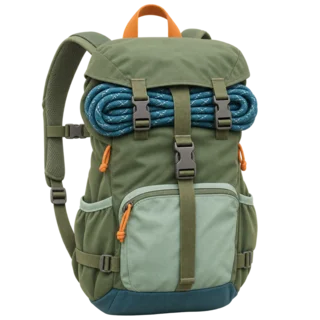
Hiking with a rope
Coil it into a hank and strap it under the lid or on the outside of the pack, where it will not snag on branches.
Seal the ends
Melt cut ends of synthetic rope or tape them so they do not unravel on the trail.
What a hand line on a trail is
A hand line, or fixed rope, is a rope tied at the top of a short steep step so people can hold it for balance as they climb up or down. Hiking rope with knots tied along it for handholds is called a knotted rope or knotted hand line. Swap the rope for steel cable bolted to rock, as in the Dolomites, and you get a via ferrata. People clip into it with a harness and lanyards.
A hand line is not fall protection. It helps you keep balance on a step where a slip means a stumble. Where a slip could mean a fall onto rocks or off an edge, a tied rope gives false security. That place needs a belay, a cable built by trail crews, or another route. The British Caving Association, which trains leaders to rig short knotted hand lines, pairs them with a leader spotting each person.
How to rig a hand line on a steep trail
Rig from the top down. Decide where hands will actually go before you tie anything, and keep the line close to the natural path so nobody cuts a new one.
Choose the top anchor. A healthy living tree, as thick as your thigh or more, or a big boulder that does not rock when you push it. Dead trees, roots at the edge and loose blocks do not count.
Protect the bark. Rope wrapped tight around a trunk can cut into bark and girdle the tree as it grows. Put a wide strap or a piece of old hose under the rope, and do not nail or screw anything to the tree.
Tie a figure-eight follow-through. Tie a figure eight in the rope, pass the end around the tree, then trace it back through the knot. It does not loosen when the rope goes slack. Finish with a stopper knot on the tail.
Sleeve the edges. Where the rope crosses a rock lip, slide a piece of garden hose over it. Rubbing on an edge wears a fixed rope out faster than sun does.
Add handhold knots. On the steepest part only, tie overhand knots about 40–50 cm apart.
Tie the bottom and take out the slack. Tie the lower end to a second anchor with the same figure-eight follow-through, so the rope cannot swing sideways. Pull it snug first: a slack line lets people lurch.
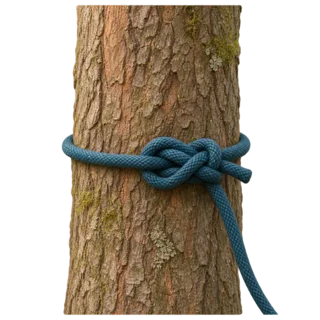
Tree anchor
A living trunk, padded, with a figure-eight follow-through and a stopper on the tail.
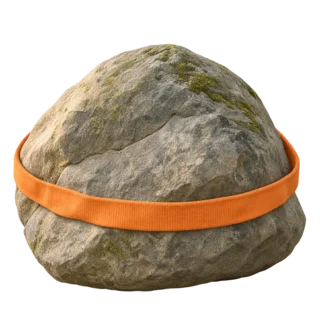
Boulder anchor
Wide webbing around a block that cannot roll or slide. Test it with your whole weight first.
Why not a bowline? It is easier to untie, but Petzl lists a backup knot as mandatory with it. Animated Knots warns that an unloaded bowline “can very readily work its way untied.” A hand line hangs unloaded most of the time.
Knotted rope: where to put the handhold knots
Knots give a wet hand something to stop against. The British Caving Association advises knots small enough that nobody can put a hand through a loop, close enough to stay within easy reach, and holding the rope just above each knot. A plain overhand knot does that. We space them 40–50 cm apart, about one forearm length, and only where people really pull on the rope.
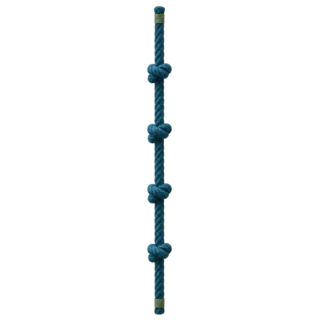
Knotted section
Overhand knots on the steep few meters. Above and below, a plain rope slides better through the hand.
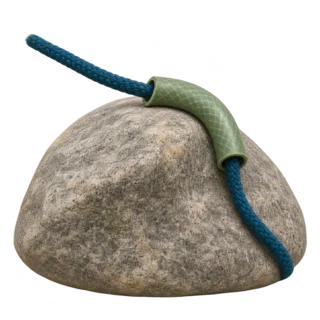
Edge sleeve
A length of hose where the rope touches rock. Petzl notes that even its rope protector does not protect against truly sharp edges, so avoid them.
Inspect and replace a hand line
The danger with an old hand line is that it looks fine until it breaks, and people trust it because it is there. No rope maker publishes a lifespan for rope left outside. Samson’s advice on when to retire a rope is simply “before it breaks.” Our own rule of thumb, not a maker figure: in strong subtropical sun we replace a polyester hand line after about two years, and we check it every few months.
Leave a note with a date. A small tag at the top anchor with the month it was tied tells the next hiker how old the rope is. If you cannot come back to check it, take the rope home with you.
Ask before you leave a rope
On public land a rope left in place is an installation, and it needs permission. On US national forests, 36 CFR 261.10 prohibits placing any structure or “other improvement” without written authorization, and leaving personal property unattended for longer than 72 hours. In national parks, 36 CFR 2.22 sets the limit for unattended property at 24 hours. In designated wilderness, the National Park Service requires authorization for new fixed anchors or fixed equipment.
Carry it, use it, take it
A rope you tie for your group and untie on the way back is ordinary hiking with a rope.
Talk to the trail’s keepers
The park office, forest ranger district or local trail club. Forest Service volunteers work only under a written agreement.
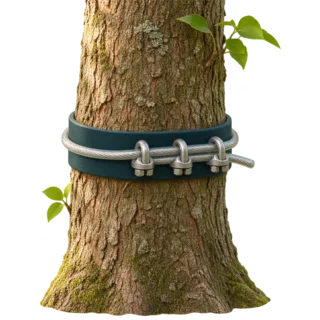
Permanent means cable
Long-lasting aids are coated steel cable with clamps over a pad, put in by crews. That is not a carry-in job.
Rope and knot guides
This page is the overview. Each guide below covers one skill in depth.
- Camping knotsThe essential knots for hiking and camping.
- How to tie a rope to a treeStrong anchors that do not hurt the tree.
- Polyester vs nylon ropeFibers for sun, water and stretch.
- How to coil a ropeFor carrying and storage.
- How to whip rope endsWhipping and sealing.
- Trucker’s hitchTight lines for tarps and guylines.
- Figure 8 follow throughAround a tree or anchor.
Hiking rope questions
What is the best rope for outdoor use?
Polyester. It resists UV and rot better than nylon and much better than polypropylene, keeps its strength wet and stretches little. For a hand line, use 11–12 mm braided static or 12–14 mm three-strand polyester.
What is hiking with ropes called?
A rope tied in place for hikers to hold is a hand line or fixed rope. Routes with steel cables and ladders bolted to rock are called via ferrata. Hiking roped together on glaciers is glacier travel, a mountaineering skill that needs crevasse-rescue training.
Is polyester rope good for outdoor use?
Yes, it is the best common fiber for it. Marlow ranks polyester top for UV resistance and lists “no strength loss when wet” for its three-strand polyester. It still degrades in sun over time, so inspect it.
Is nylon rope good for outdoor use?
For carrying and short use, yes. For rope that stays outside, it is second best: it fades faster than polyester, absorbs water and can lose up to 20% of its strength when wet.
Is polypropylene rope good for outdoor use?
No, not for anything that holds people. It floats and is cheap, but it breaks down in sun far faster than polyester or nylon.
Does polyester rope stretch?
Very little. Sterling lists 1.9% elongation at 300 lb for its 11 mm polyester static rope, which is why a polyester hand line feels firm.
What is the strongest knot for tying rope to a tree?
Every knot weakens rope somewhat. For a hand line we use a figure-eight follow-through around the trunk with a stopper on the tail: it holds well and does not loosen when slack.
How often should you replace a rope left outside?
No maker gives a fixed number. Check it every few months and replace it when it is faded, stiff, fuzzy or cut. Our rule of thumb in strong sun is to replace a polyester hand line after about two years, even if it looks fine.
How do you make a knotted rope for climbing a steep step?
Tie overhand knots about 40–50 cm apart on the steep section, small enough that a hand cannot slip through a loop. Anchor the top to a living tree or solid boulder and tie off the bottom.
What is fixed rope climbing?
In mountaineering, a fixed rope is anchored along a route so climbers can clip in with ascenders, as on big expedition peaks. That needs harness, training and belay skills, unlike a hiking hand line.
Ready to plan a trip? Find a route and check its steep sections before you pack a rope.